How to Play Roulette: Every Bet, Payout, and Strategy Explained
How to play roulette comes down to three decisions: which wheel you sit at, which bets you place, and how much of your bankroll you put behind each spin. Everything else is out of your hands. That makes roulette one of the easiest casino games to learn, and one of the most misunderstood.
This page covers the table layout, every bet and its payout, the differences between European, American, and French wheels, the betting systems people swear by, and the myths that cost players money. You can also learn by actually playing.
Start the Free TrainerThe Free Roulette Trainer
The free trainer on this page teaches roulette in short chapters, awards XP, and posts a daily leaderboard. Reading explains the game; playing makes it stick.
What Is Roulette?
Roulette is a casino table game built around a spinning wheel with numbered pockets. The dealer, called a croupier, spins the wheel one way and rolls a small ball along the rim the other way. When the ball loses momentum, it drops into a pocket, and that pocket’s number decides every bet on the table.
The numbers run 1 through 36, half red and half black, plus one or two green zero pockets depending on the wheel. Before each spin, players place chips on the layout to predict where the ball will land: a single number, a group, a color, odd or even. Each bet pays fixed odds, so a riskier prediction pays more when it hits.
The name comes from French and means “little wheel,” and the game has run in casinos since the late 1700s with barely a rule change. What has changed is where you play: the same game now runs online, with table minimums far below what a Vegas floor charges.
The Wheel: European vs American vs French
Not all roulette wheels are the same game, and the difference is the most important thing a new player can learn.
| Variant | Pockets | Zeros | House edge (most bets) | House edge (even-money bets) |
|---|---|---|---|---|
| European | 37 | 0 | 2.70% | 2.70% |
| American | 38 | 0 and 00 | 5.26% | 5.26% |
| French | 37 | 0 | 2.70% | 1.35% with La Partage |
The European wheel has 37 pockets: the numbers 1–36 plus a single green zero. Every standard bet on it carries a house edge of 2.70%.
The American wheel adds a second green pocket, the double zero, for 38 in total. Payouts stay identical, so that one extra pocket nearly doubles the house edge to 5.26%. Same bets, same payouts, twice the cost. The American layout also offers the basket bet on 0, 00, 1, 2, and 3, which pays 6:1 and carries a 7.89% house edge: the worst bet on the table.
The French wheel is physically a European wheel with one rule change on even-money bets. Under La Partage, when the ball lands on zero, red/black, odd/even, and high/low bets lose only half instead of everything. Its cousin En Prison locks the bet in place for one more spin instead, with the same expected value. Either rule cuts the even-money house edge to 1.35%, the lowest number in the game.
One more difference hides on the wheel itself: the number sequence. On the European wheel, zero sits between 26 and 32, in an order designed to scatter high and low around the rim; the American wheel uses a completely different sequence, with 0 and 00 facing each other from opposite sides. The order never changes your odds, but it matters for the sector bets covered further down.
The Table & Every Bet Type
The betting layout is a grid of the numbers 1–36 in three columns, with the zeros at the top and the group bets along the outside. Where you place your chips determines what you’ve bet, so it pays to know the spots.
Inside bets go on the number grid itself:
- Straight Up: one chip squarely on a single number. Pays 35:1.
- Split: a chip on the line between two adjacent numbers. Pays 17:1.
- Street: a chip on the outer edge of a row of three. Pays 11:1.
- Corner: a chip on the intersection where four numbers meet. Pays 8:1.
- Six Line: a chip on the outer edge spanning two rows, covering six numbers. Pays 5:1.
Outside bets sit in the boxes around the grid. A Column covers one of the three vertical columns of twelve numbers; a Dozen covers 1–12, 13–24, or 25–36. Both pay 2:1. The even-money bets are red/black, odd/even, and low/high (1–18 or 19–36), each covering eighteen numbers and paying 1:1. The zero counts as a loss for every outside bet; it belongs to no color, no dozen, no half.
| Bet | Pays | Numbers covered | Win chance (European) | Win chance (American) |
|---|---|---|---|---|
| Straight Up | 35:1 | 1 | 2.70% | 2.63% |
| Split | 17:1 | 2 | 5.41% | 5.26% |
| Street | 11:1 | 3 | 8.11% | 7.89% |
| Corner | 8:1 | 4 | 10.81% | 10.53% |
| Six Line | 5:1 | 6 | 16.22% | 15.79% |
| Basket (American only) | 6:1 | 5 | — | 13.16% |
| Column | 2:1 | 12 | 32.43% | 31.58% |
| Dozen | 2:1 | 12 | 32.43% | 31.58% |
| Red/Black, Odd/Even, 1–18/19–36 | 1:1 | 18 | 48.65% | 47.37% |
You can place as many bets as you like on one spin. The trainer on this page shows your total wheel coverage live as you place chips, the fastest way to build a feel for how the bets overlap.
Roulette Payouts Explained
Roulette payouts are quoted as odds. A 35:1 payout means a winning bet earns 35 times your wager in profit, plus your original chips back. Put $10 on a single number and hit it, and the dealer pushes you $350 in winnings plus your $10: $360 in total.
The question people search for most: how much do you win with $100 on red? Red pays 1:1, so $100 on red returns $100 in profit plus your original $100, for $200 total. On a European wheel that bet wins 48.65% of the time; on an American wheel, 47.37%.
Now for where the house edge comes from. On a European wheel, a single number has 36 ways to lose and 1 way to win, so the true odds against it are 36:1. The casino pays 35:1. That one-unit gap on every payout, priced as if the zero didn’t exist, is the entire trick of the game. Work it out and every bet on the European wheel costs the same: an expected loss of 2.70 cents per dollar wagered, or 5.26 cents on the American wheel.
That is also why “which bet should I place?” has no mathematical answer on a given wheel: a straight-up bet and a red bet lose at the identical long-run rate. The real decisions are which wheel you play, and whether your table offers La Partage.
French Called Bets & the Racetrack
Many French and European tables carry a second, oval-shaped betting area: the racetrack. Because the numbers on the wheel don’t match the order on the layout, betting on a physical section of the wheel requires combination bets. These are the called bets, or annonces, and three classics divide the wheel between them.
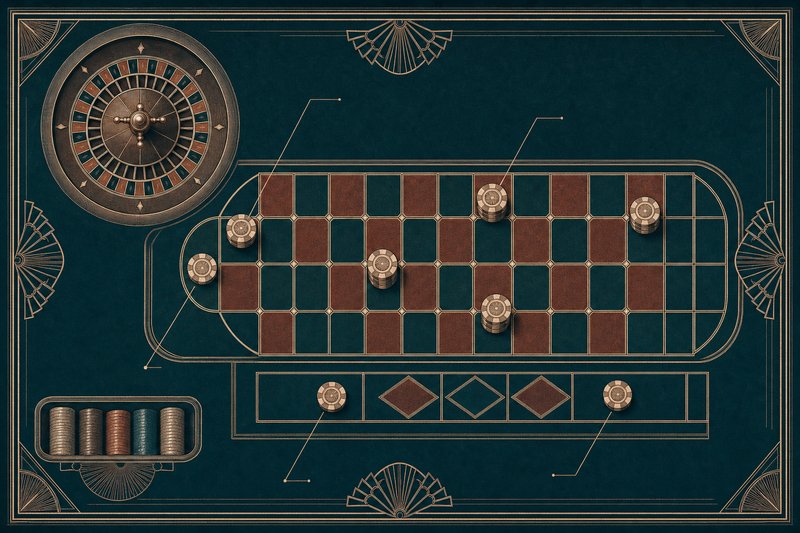
Voisins du Zéro (“neighbors of zero”) covers the 17 numbers around the zero. It costs 9 chips: 2 on the 0-2-3 trio, 2 on the 25/26/28/29 corner, and 1 each on the splits 4/7, 12/15, 18/21, 19/22, and 32/35.
Tiers du Cylindre (“third of the wheel”) covers the 12 numbers roughly opposite the zero. It costs 6 chips, one on each of the splits 5/8, 10/11, 13/16, 23/24, 27/30, and 33/36.
Orphelins (“orphans”) picks up the 8 numbers the other two leave behind. It costs 5 chips: 1 straight up on the number 1 and 1 each on the splits 6/9, 14/17, 17/20, and 31/34, with 17 covered twice.
Together the three bets tile the entire European wheel: 17 + 12 + 8 = 37 pockets. Every chip in them is an ordinary split, corner, or straight-up bet underneath, so the house edge stays exactly 2.70%.
Roulette Strategies & Betting Systems
Every roulette betting system does the same thing: it changes how much you bet based on what just happened. None of them change the probability of any spin or the house edge on any bet. They do shape the experience of a session, so they’re worth understanding. Each one below runs in the simulator on this page, where you can watch a thousand sessions play out in seconds.
Martingale
Double your bet after every loss, return to base after a win. Each win recovers everything lost plus one unit, which sounds airtight until you meet a losing streak. Starting at $5, seven straight losses cost $635 and require a $640 bet next, past the $500 maximum many tables enforce. On a European wheel, an even-money bet loses seven in a row about once every 106 sequences. Run enough spins and the streak finds you, erasing dozens of small wins at once.
Grand Martingale
The aggressive version: after a loss, double your bet and add one base unit, so a win banks extra profit instead of just breaking even. The bets escalate even faster, so the table limit and your bankroll both arrive sooner. Higher highs, much earlier ruin.
Fibonacci
Bet sizes follow the sequence 1, 1, 2, 3, 5, 8, 13, 21: one step forward after a loss, two steps back after a win. The climb is gentler than doubling, but a bad stretch still walks you into serious money, and a single win no longer repairs a long losing run the way Martingale’s does.
D’Alembert
Add one unit to your bet after a loss, subtract one after a win. It’s the flattest progression and the easiest on a bankroll, which makes it feel safe. The house still collects 2.70% of everything you put on a European table; D’Alembert just hands it over slowly.
Labouchère
Write down a line of numbers, classically 1-2-3-4. Each bet is the sum of the first and last numbers (5 units to start); a win crosses both off, a loss appends the lost amount to the end. Clear the line and you’ve won the sum of the original numbers. The catch: losses grow the line faster than wins shrink it, so bad sessions end with a long line and a large required bet.
James Bond
A fixed layout rather than a progression, played in $20 units: $14 on high (19–36), $5 on the six line 13–18, and $1 straight up on zero. That covers 25 of 37 pockets, so most spins win something: $8 profit on a high number, $10 on 13–18, $16 on zero. The remaining pockets, 1–12, lose the full $20 and hit 32.4% of the time. Frequent small wins, and an average loss per spin identical to putting the same $20 anywhere else.
1-3-2-6
A positive progression: raise your bets during winning streaks instead of losing ones. On even-money bets you wager 1 unit, then 3, then 2, then 6, stepping forward only after a win; any loss, or completing the cycle, resets you to 1. Four straight wins bank 12 units. It caps losing spins at small bets, and like all the others it leaves your expected result untouched.
The Strategy Simulator
Don’t take our word for any of this. The simulator on this page runs each system with a $200 bankroll, $5 base bets, a $500 table cap, and 200 spins per session, across 1,000 sessions at a time. Every system converges on the same number: about 2.7 cents lost per dollar wagered on a European wheel. The system only decides the shape of the ride.
Do Betting Systems Actually Work? Myths, Busted
“After ten reds, black is due.” This is the gambler’s fallacy, the most expensive belief in roulette. The wheel has no memory. After ten reds in a row, the chance of red on the next spin is still 48.65% on a European wheel, exactly what it was on spin one. Streaks are what randomness looks like.
“Play the hot numbers.” Casinos display recent results precisely because players act on them. Over a few hundred spins, some numbers will have hit noticeably more often than others by pure chance. That tells you what happened, and nothing about what happens next: every number’s probability remains 1 in 37 on every spin.
“Dealers can aim the ball.” A dealer would need to control the wheel speed, the ball speed, and the chaotic scatter as the ball bounces across the pocket separators, spin after spin. Modern wheels are engineered and audited to prevent exactly that.
“Some bets are smarter than others.” On a European wheel, every bet, from a straight-up number to red, has the same expected value: −2.70%. There is no clever corner of the layout. The genuinely smarter moves are choosing a 37-pocket wheel over a 38-pocket one, playing even-money bets where La Partage applies, and never touching the American basket bet.
So do betting systems work? They work at deciding your bet sizes, and they fail at their advertised job of beating the wheel. Anyone selling you a guaranteed roulette system is selling the gambler’s fallacy with a price tag.
Playing Online vs In a Casino
The game is identical in both places; the experience isn’t.
In a casino, you buy in at the table and receive color-coded chips unique to you, so the dealer can track whose bets are whose. Place your own chips anywhere you can reach, and ask the dealer to place far-side numbers for you; that’s normal, not rude. Betting stays open while the ball circles the rim, until the dealer waves a hand and announces “no more bets.” From that moment, touch nothing. The dealer marks the winning number with the dolly, clears the losers, and pays the winners; wait until the dolly is lifted before betting again. Exchange your color chips at the table before you leave, since they’re worthless anywhere else, and tip the dealer occasionally.
Online, two versions exist: RNG roulette, which uses a certified random number generator and runs as fast as you click, and live dealer roulette, which streams a physical wheel with a human croupier. Online tables have real advantages: minimums often start under a dollar, free demo modes let you practice without risk, and French tables with La Partage are far easier to find than on an American casino floor, where double-zero wheels dominate. The speed cuts both ways: more spins per hour means the edge works on your bankroll faster, so session limits matter more online, not less.
If you decide to play for real money, the operator you pick matters as much as the wheel. We compare licensed roulette sites on our homepage, with wheel variants, table limits, and license details for each one.
Smarter Play: Practical Tips
No strategy can win at roulette in the long run, and this page won’t pretend otherwise. But playing well instead of badly is worth about four percentage points.
- Pick the right wheel. French rules with La Partage (1.35% on even-money bets) beat European (2.70%), and both crush American (5.26%). This choice matters more than every betting system combined.
- Prefer even-money bets where La Partage applies. Red/black on a French table is mathematically the best bet in roulette.
- Never play the basket bet. At 7.89%, it costs nearly three times the European edge.
- Set a session bankroll before you play, money you can lose without consequence, and size your bets at 1–2% of it. A $200 bankroll means $2–4 chips.
- Decide your quit points in advance: a loss limit and a win target. Walking away up $50 only counts if you actually walk.
- Never chase losses. Raising your bets to “win it back” is the Martingale trap in casual clothing.
- Count roulette as entertainment, priced at roughly 2.7 cents per dollar wagered on a good wheel. If that reads like a fair price for the fun, play. If not, the trainer on this page is free.
Responsible Gambling
Roulette should stay a game. If you’re betting money you need, hiding sessions, or chasing losses, help is free and confidential: call or text 1-800-GAMBLER, available 24/7 across the US. Online casinos are legal only in a handful of states, each with its own regulator, and every licensed operator must offer deposit limits, time-outs, and self-exclusion tools. Use them early rather than late. You must be 21 or older to play real-money casino games in most US states.
Frequently Asked Questions
How do you play roulette for beginners?
Buy chips at the table, place them on the betting layout to predict where the ball will land, and wait for the spin. Start with even-money bets like red or black, which win almost half the time. The free trainer on this page teaches every bet type hands-on, one chapter at a time.
What is roulette?
Roulette is a casino game in which a ball is spun around a numbered wheel and players bet on where it will land. The wheel holds the numbers 1–36 in red and black plus one or two green zeros, and each bet pays fixed odds. It has been a casino staple since 18th-century France.
How does roulette work?
Players place chips on numbers, groups, or colors, the croupier spins the wheel and ball, and the pocket the ball lands in decides every bet. Winners are paid at fixed odds, from 1:1 for red or black up to 35:1 for a single number. Payouts sit slightly below the true odds, which is how the casino earns its edge.
What’s the fastest way to learn how to play roulette?
Play it without risking money. Our free trainer breaks the game into short chapters covering bets, payouts, and wheel types, checks your decisions against the exact math, and awards XP as you improve. Most people understand the whole table within half an hour.
How do you win at roulette?
Any single spin can win, but no method wins reliably over time, because every bet pays slightly less than its true odds. What you can control is the cost: French wheels with La Partage charge 1.35% on even-money bets, versus 5.26% on American wheels. Pick the right table, size your bets sensibly, and quit while you’re ahead.
Can you play roulette and win in the long run?
No. Every bet on a European wheel carries a −2.70% expected value, and no betting system or number pattern changes that. Players win individual sessions all the time, but the math guarantees the house wins across all players over time.
How do you win at online roulette?
The same math applies online: choose European or French tables over American ones, and prefer even-money bets where La Partage applies. Online adds lower table minimums and free demo play for practice. Only play at licensed sites, and treat any “guaranteed winning system” as the scam it is.
How many numbers are on a roulette wheel?
A European or French wheel has 37 pockets: the numbers 1 through 36 plus a single green zero. An American wheel has 38, adding a double-zero pocket. That one extra pocket is why the American house edge is 5.26% versus 2.70% in Europe.
How many numbers are in roulette?
The game uses 36 main numbers, 18 red and 18 black, plus the green zeros: one in European and French roulette, two (0 and 00) in American roulette. All outside bets, including red and black, lose when the ball lands on any zero.
How do you play roulette in a casino?
Join a table between spins and buy in; the dealer gives you color chips that mark your bets as yours. Place chips on the layout until the dealer calls “no more bets,” then keep your hands clear until the winning number is marked and paid. Cash your color chips back at the same table before leaving.
How does a roulette wheel work?
The croupier spins the wheel one way and rolls the ball along the rim the other way. As the ball slows, it drops off the rim, bounces across deflectors and pocket separators, and settles in one numbered pocket. The bouncing makes each result effectively random, and no spin is influenced by the ones before it.
What is the payout on roulette?
Payouts range from 1:1 on even-money bets up to 35:1 on a single number, with splits at 17:1, corners at 8:1, and dozens or columns at 2:1. A winning bet also returns your original chips, so $100 on red pays $100 profit and $200 back in total.