European or American Wheel? What Roulette Players in Canada Should Know
Most decisions at a roulette table change nothing. Red or black, a single number or a dozen, an inside bet or an outside one: on any given wheel they all lose at the same long-run rate. The one choice that moves the math is made before a chip goes down, and it is which wheel you sit at.
For players in Canada that choice is less obvious than it sounds. The casino floor and the online lobby tend to offer different wheels, the province you are in decides which lobbies you can open, and a table’s name does not always say how many zeros it carries. This piece sets out what the two wheels cost and where each one turns up.
One Green Pocket, Twice the Price
A European wheel has 37 pockets: the numbers 1 to 36 and a single green zero. An American wheel has 38, because it adds a second green pocket marked 00. Nothing else about the game changes. The layout carries the same bets, and every one of them pays the same amount on both wheels.
That is exactly where the difference comes from. A straight-up bet pays 35 to 1 whether there are 37 pockets or 38, so the payout is priced as though the wheel had 36 numbers and no zero at all. On the European wheel the gap between the true odds and the paid odds works out to one pocket in 37, a house edge of 2.70 percent. On the American wheel it is two pockets in 38, or 5.26 percent.
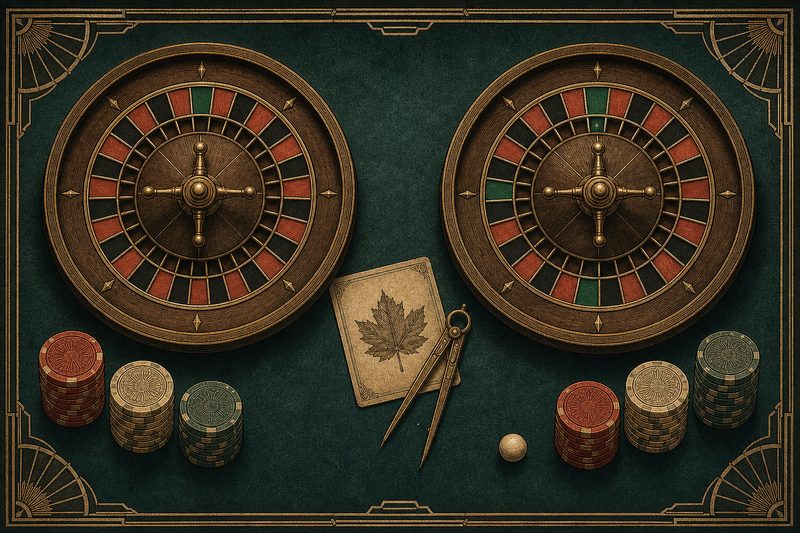
The same arithmetic shows up in the bets people actually place. A chip on red wins 18 times in 37 on a European wheel, which is 48.65 percent of spins. On an American wheel it wins 18 times in 38, or 47.37 percent. A single number comes in once every 37 spins on average instead of once every 38, a difference nobody would notice in an evening, yet the payout for hitting it is identical. The roulette payout math on this site walks through the calculation bet by bet, and it lands on the same two figures every time.
It is tempting to read 2.70 against 5.26 as a small gap between two small numbers. It is better read as a ratio. The American wheel charges almost double for the same game, and it offers nothing in exchange: no bigger payouts, no extra bets worth having, no rule that hands part of the edge back.
What the Difference Costs in an Evening
House edge is a percentage of everything you wager, not of what you bring to the table, and that is why it adds up faster than most players expect. A live dealer table gets through roughly 60 spins an hour. At C$10 a spin that is C$600 in action, on which the European wheel expects to keep about C$16 and the American wheel about C$32.
Software tables move the numbers further. An RNG wheel spins as quickly as you can click, and 200 spins an hour is an unhurried pace. The same C$10 stake now puts C$2,000 through the table every hour, for an expected cost of C$54 on a single-zero wheel and a little over C$105 on a double-zero one. Stretch that across a month of regular play and the second green pocket has quietly become the largest expense in the hobby.
None of this can be bet around. Progressions such as Martingale or Fibonacci rearrange when the wins and losses arrive, but each individual stake still faces the edge of the wheel it is placed on. A system run on an American wheel loses at 5.26 percent of turnover, and the same system on a European wheel loses at 2.70 percent. Switching wheels is the only adjustment that changes the figure.
There is one way to do better than 2.70, and it is a rule rather than a wheel. French roulette is played on the European wheel with La Partage, which returns half of a losing even-money bet when the ball lands on zero. On red or black, odd or even and high or low, that cuts the edge to 1.35 percent. The rule does not touch inside bets, so a player who only backs single numbers gains nothing from it.
What Else Changes Between the Two Wheels
The extra pocket is the headline, but it is not the only thing that separates the two games. The numbers run in a different order around the rim. On a European wheel the zero sits between 26 and 32, and the sequence is arranged to scatter high and low, odd and even. On an American wheel the 0 and the 00 face each other across the cylinder, and consecutive numbers sit directly opposite one another.
That matters for one group of players in particular. The called bets on a French or European table, Voisins du Zéro, Tiers du Cylindre and Orphelins, cover physical arcs of the single-zero wheel, and the oval racetrack that makes them easy to place is drawn for that sequence. Double-zero tables do not carry them, so anyone who likes to bet sections of the wheel is choosing the European game whether they have thought about the house edge or not.
The American layout does add one bet of its own. The five-number basket covers 0, 00, 1, 2 and 3 and pays 6 to 1, which puts its house edge at 7.89 percent. It is the only bet on either table that is worse than the wheel it sits on, and it is the single piece of advice every guide to the American game agrees on.
A third wheel has also appeared on some casino floors, with a 000 or a logo pocket alongside the 0 and 00. Its 39 pockets push the edge to 7.69 percent. It is rare online and uncommon in Canada, but it is worth knowing that the scale does not stop at two zeros.
Which Wheels Canadian-Facing Casinos Usually Offer
Where you can play depends on where you are standing. Ontario has run an open market since April 2022, with private operators registered by the Alcohol and Gaming Commission of Ontario and managed by iGaming Ontario. Alberta opened its own market to private operators in July 2026. In the other provinces, online casino play runs through a government platform such as PlayNow in British Columbia, Manitoba and Saskatchewan, Espacejeux in Quebec, or the Atlantic Lottery site. Our guide to Canadian roulette sites covers that map in more detail.
The wheels on offer are more uniform than the licensing. On Canadian casino floors the double-zero wheel is still the common one, a habit shared with the United States, and single-zero tables tend to be the exception where they exist at all. Online the position is reversed. A regulated Canadian lobby will normally lead with European roulette in both its software and live dealer sections, because the handful of studios that supply live tables to these markets build most of their catalogue around the single-zero wheel.
Lists of the best online casinos in Canada usually rank operators on licensing, payout speed and the overall size of the game library, and the roulette wheel rarely gets a line of its own. That is a reasonable way to judge a casino and an incomplete way to judge a table. When a newspaper roundup of the best Canadian online casinos names an operator, the useful next step for a roulette player is to open its table games section and count the zeros, since two sites holding the same registration can stock quite different wheels.
American roulette has not disappeared from those lobbies. Most carry at least one double-zero table, usually labelled plainly as American Roulette, and it sits in the same row as the European version with nothing to flag that it costs twice as much to play. French tables with La Partage are less common but far easier to find online than in a Canadian casino, and some live studios run them under names that mention the rule rather than the country.
Regulation helps with the reading. Ontario’s Registrar’s Standards for Internet Gaming include requirements on game integrity and player awareness, and registered operators publish the rules and payouts for each game they offer. Sites that take Canadian players from outside any provincial framework are under no such obligation, and their roulette lobbies are where unlabelled double-zero tables and unusual house rules are most likely to appear.
How to Tell Which Wheel You Are Looking At
The table name is the first clue and the least reliable one. European, French and American mean what they say, but plenty of tables are named after a feature or a studio and leave the wheel unstated. The betting layout settles it in a second: if there is a 00 box beside the 0 at the top of the grid, it is a double-zero game.
The information panel inside the game is the definitive source. Regulated tables state their theoretical return to player there, and the figure identifies the wheel on its own. A return of 97.30 percent is a single-zero wheel. A return of 94.74 percent is a double-zero wheel. Anything close to 98.65 percent on even-money bets means La Partage or En Prison is in force.
Variants with multipliers deserve a second look. Several popular live games spin a single-zero wheel but pay less than 35 to 1 on an ordinary straight-up win, using the difference to fund occasional boosted payouts on randomly chosen numbers. The outside bets on those tables usually keep the standard 2.70 percent edge, while the straight-up bets carry a slightly higher one. The wheel is European, but the game on top of it is not quite the one in the textbook, and the information panel is again where the real figure is printed.
Table limits are the last thing to check. A single-zero table with a minimum several times higher than the double-zero table next to it is a common arrangement on casino floors, and it can make the cheaper wheel the more expensive one to sit at. Online that trade-off mostly vanishes, since European tables are routinely available at the lowest stakes in the lobby. Before any of that, it is worth confirming that the operator itself holds up, and the checks in how roulette players spot a safe casino take about a quarter of an hour.
The Bottom Line
The two wheels are the same game at two different prices. The European wheel costs 2.70 percent of everything wagered, the American wheel costs 5.26 percent, and French rules bring even-money bets down to 1.35 percent. No bet selection and no staking plan changes those figures, which makes the choice of table the one decision in roulette that is entirely in the player’s hands.
For players in Canada the practical position is a comfortable one. Regulated online lobbies generally put single-zero tables first, and the double-zero wheel is something you have to choose rather than something you are left with. The order of preference is short: French where it is offered, European otherwise, and American only when it is the sole table open and you have decided the higher cost is worth it.